Tag Archives: Waterfalls

Mindo, Ecuador – Impressions

80km north of Quito is the town of Mindo, buried deep in the rainforest of North Ecuador.

As one of my friends leaves South America in the next week three of us, who’ve been hanging out in Quito, decided to go away for the weekend to have one last adventure together. Spending $8 in the taxi to the bus terminal, we paid $2.50 each for the 2 hour bus ride!

Mindo is a charming little town with a lot to offer, which is why it’s a common weekend destination for travellers stopping off in Quito. While it’d take a week to do everything on offer here, with only two days we decided to take it easy and enjoy ourselves.

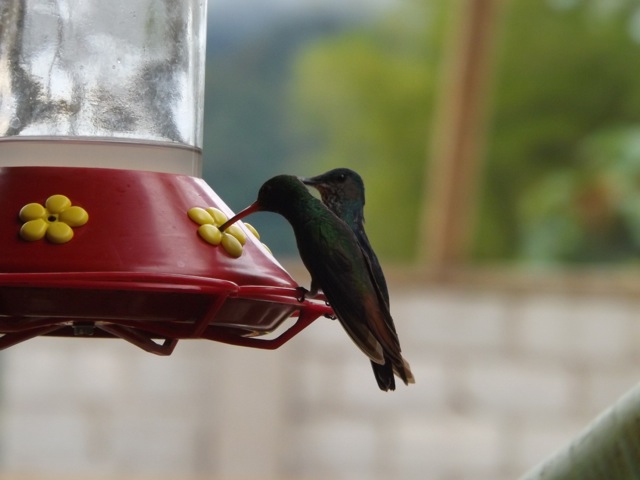
To start with, we found a place that served breakfast and ordered. While we were waiting on the balcony for the food to arrive, Hummingbirds flitted around, stopping to drink from a feeder.

wpid-dscf2404-2013-10-6-18-53.jpg

They skit and bob around like insects with their wings blurred and are the only birds that can fly backwards. It was impossible to get a clean photo of them while they were flying as the camera just couldn’t focus on them fast enough. There are 14 different types of them here.

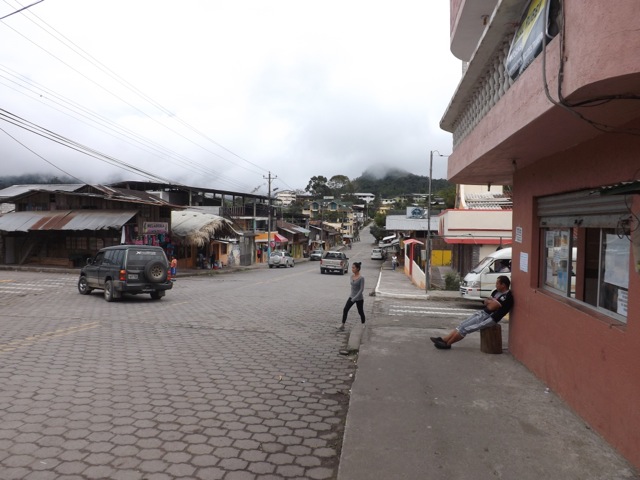
After breakfast, we went for a walk to check out what the town had to offer. 10 minutes later, we were done having seen the bar district and the restaurant district. The town consists of a main street, several short side streets and a plaza.

wpid-dscf2402-2013-10-6-18-53.jpg

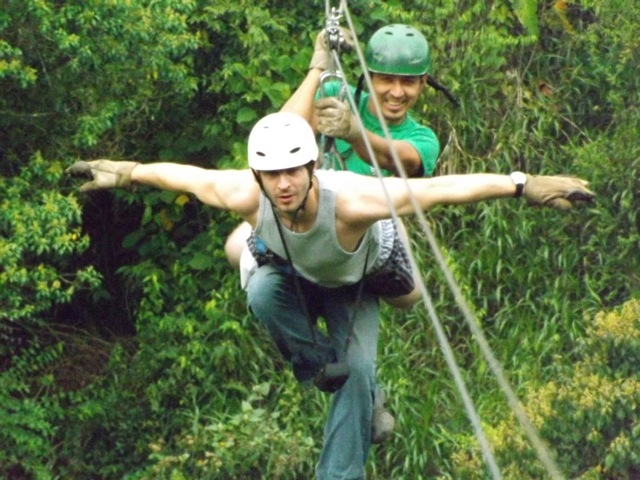
Next, we decided to go zip lining and walked the 3km up the hill to one of the companies that offered it. There were 10 different lines and on most of them we were able to ‘fly’ while accompanied by one of the two guides. Hanging from our backs we sped along with arms wide, aeroplane style. Overall, it was a most fun two hours.

wpid-dscf2438-2013-10-6-18-53.jpg

That evening, we headed out to the bar district for tapas and sangria. We discovered we were some of the only foreigners in town that night, so after eating, we headed back to hostel for our own little party, just the three of us.

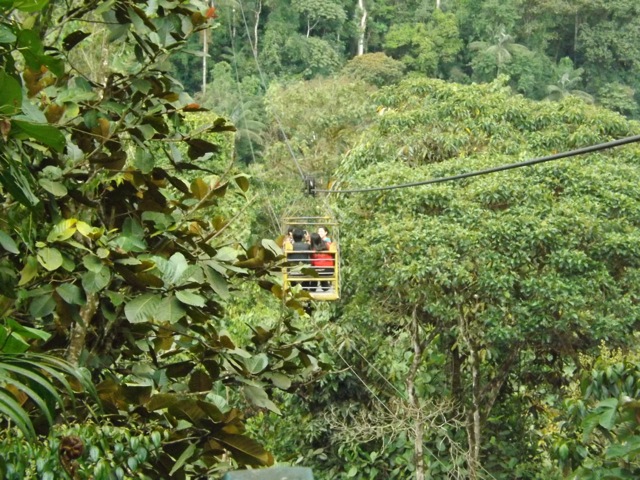
We woke late the next day and after breakfast, decided to visit the waterfalls. By the time we headed up there it was early afternoon. To get to the falls, we caught a taxi the 10km to a home-made cable car which took us across the valley. The engine was made from an old van with gears and all…

wpid-dscf2467-2013-10-6-18-53.jpg

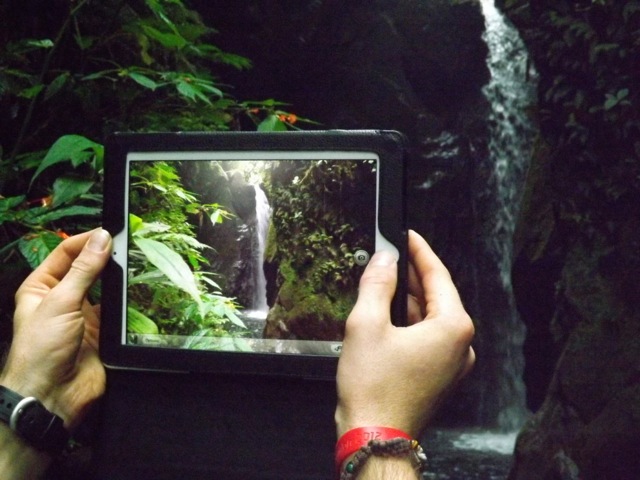
On the other side of the valley, we walked down a dirt trail in the rainforest for some time arriving at some of the waterfalls. Hot from the walk, two of us donned our swimmers and leapt in, and out again, as the water was as cold as expected. There are 7 sets of waterfalls in the area, but in the two hours before the cable car stopped for the day we got to four of them.

wpid-dscf2477-2013-10-6-18-53.jpg

That evening we hung out with a group of new arrivals at the hostel before heading to bed early. While we had only two days in the town, there are many other things we could have done, including canyoning (where you rappel down a waterfall), tubing down a river (like rafting but large tire tubes tied together) and an animal sanctuary, to name a few.

It’s a peaceful change from the city and at the price to visit and stay, it is well worth the effort if you are in Quito with a few days to spare. Just remember to take your Malaria tablets and try to avoid mosquitos, although it was the midges that feasted on us.

Next, it’s back to Quito to prepare for a four day walk around Cotopaxi, one of the world’s tallest active volcanos.

The Trail Wanderer

Santa Cruz trek, Cordillera Blanca, Peru

While there are many hikes in the Cordillera Blanca, the Santa Cruz hike is the most popular, and is usually done with a guide. Hiking with a guide doesn’t feel like true hiking, especially when they carry half of the equipment, set up tents and prepare your food. So, I decided to do it without one. As it happens, four Americans at my hostel were also planning to go guideless. And while I prefer to hike alone, I wouldn’t be totally alone in the mountains… We booked a bus to the start and prepared to leave early the following morning.

Day 1

Not having a good night’s sleep the night before a hike is a bad thing. I discovered this on the Colca Canyon hike and well, it seemed to happen again!

The bus trip to the beginning of the hike is five hours on a local bus. Unlike the five of us lads, peruvians have short legs, so there was not a lot of room in the bus. The cramped first two hours of the trip was on a sealed road and then the last three hours was to be on a very rocky dirt road. Five minutes onto that dirt road, however, the bus gave up and with black smoke pouring out the side, the transmission fell out. The pool of red transmission fluid under the bus is not obvious in this photo, but it’s there…

wpid-dscf2031-2013-09-13-13-322.jpg

After an hour the bus was fixed, but only enough for it to return to base leaving us to wait for another one. Three hours later it arrived and we were on our way again. Three hours of jaw rocking dirt road meant no napping for me!

We were delivered to the small village of Yanama and discovered a group of three girls and a french couple who were also doing the hike without a guide. While the french couple were quite typical of many french people I’ve met in South America so far – they treated us like we didn’t exist and totally avoided us – the three girls decided to join the group. With eight of us, and two particularly chatty girls, my hike was going to be noisier than I wanted. So, I let the other seven head off and dropped to the back to walk alone.

The first part of the hike leads out of Yanama and down the hill via a steep dry track, crossing one dirt road on the way and eventually the river via a concrete bridge. I headed left as the trail widened leading through a couple of villages where every small child ran up and demanded bon-bons. Never give the kids bon-bons!

wpid-dscf2033-2013-09-13-13-322.jpg

Finally, I came to my first climb of the day. It wasn’t a large one but my lack of sleep caused me to struggle up it. I met the others at the top and stopped for a rest as they headed off again. I was hoping there wasn’t going to be many more climbs as the direct sunshine on top of my tiredness was draining. But there were a few. Eventually, I rounded a bend in the valley and saw a group of tents a couple of kilometres away and figured this was my companions. I set out towards them, making slow progress across some small hills.

wpid-dscf2034-2013-09-13-13-321.jpg

I was getting close to the tents when I came across a pair of cows on the trail, staring me down. Did you know that more hikers are killed every year by cows than anything else? It’s true! Google it. Not wishing to be trampled to death for getting too close, I went around, through a boggy area of ground. Exhausting!

wpid-dscf2037-2013-09-13-13-321.jpg

I finally made it to the tents to discover it wasn’t my group but a guide and his party. He pointed me further along the trail, so I struggled on. After another kilometre I still hadn’t located my amigos and with the trail leading up some hills, I picked a spot for a camp near the river and set up my tent. After cooking dinner and getting ready for the next day, I slumped into my sleeping bag and slept.

Day 2

From my planning, I was aware that Day 2 was the most difficult day of the hike. From my camp at 3,800 metres (above sea level) I would walk 13 kilometres and climb nearly a kilometre to a pass called Punta Union at a height of 4,750 metres. Followed by a further 3 kilometres down the other side.

While The Choro trek in Bolivia began 50 metres higher, I only had to climb 100m total before descending on that hike. If that 100m was hard because of the altitude, this one was going to be a very difficult day indeed fighting the altitude the entire way.

wpid-dscf2041-2013-09-13-13-321.jpg

I packed up and left my camping spot. After a fairly good sleep, I had more energy, so I set off along the trail with more vigour. But while climbing hills was still hard, it was easier than day 1.

wpid-dscf2047-2013-09-13-13-321.jpg

After a kilometre, I found the empty campsite where the other seven had camped. I headed along the valley slowly climbing as I went. As the day progressed I climbed higher along the valley. I consider any height above 3,700m to have a thin atmosphere – with less air pressure. Being a large framed, large lunged person, the higher I went the more trouble I had getting enough air and spent a lot of the time out of breath. There was a point where I had to take a break to catch my breath after every 10 steps; but only when climbing.

I climbed slowly over small knolls and past several tarns – small mountain lagoons, with towering snow covered mountains and glaciers across from me. I came over a knoll to see the ridge line I still had to climb, with the small gap at the top that was the pass.

wpid-dscf2054-2013-09-13-13-321.jpg

I continued on and the higher I went, the harder it became. Every five steps I had to take a rest to get my breath back. I even took my pack off every 100m or so for a longer break. As I climbed, my rate got slower and with only about 50 metres to the gap I slowed to only 3 steps before resting. Then for the final few metres it was only one step before resting. So…slow… But I did have a good view back along the valley.

wpid-dscf2058-2013-09-13-13-32.jpg

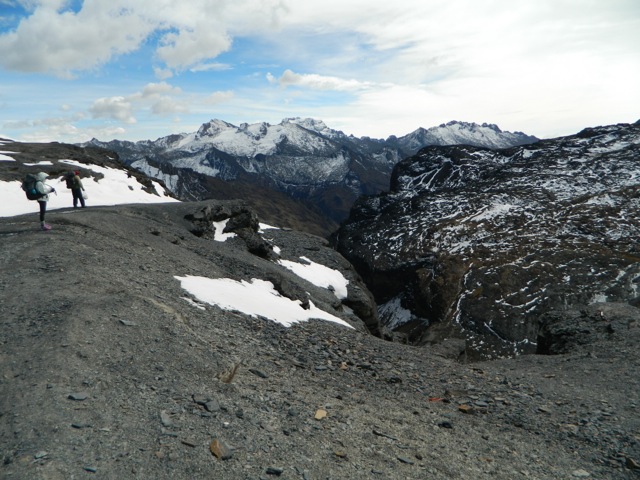
When I finally went through the gap, I passed an altitude marker and slumped down on the other side in the sun, taking my pack off and uttering, ‘Thank f**k for that!”
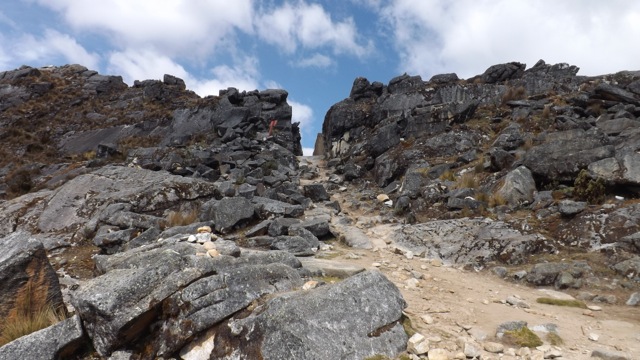
wpid-dscf2062-2013-09-13-13-32.jpg

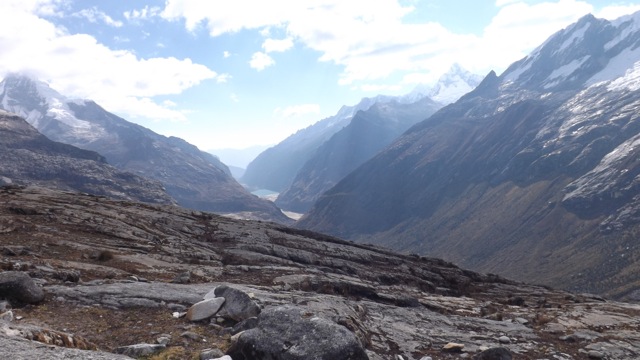
Down was a lot easier and I powered through the switchbacks below a massive white glacier…

wpid-dscf2063-2013-09-13-13-32.jpg

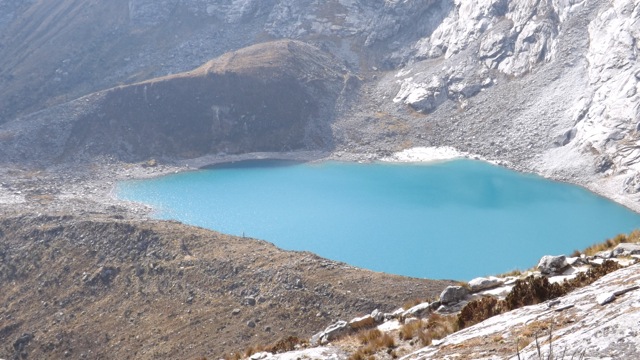
…and above an azure mountain lake.

wpid-dscf2067-2013-09-13-13-32.jpg

I could see tents in the distance and marched on feeling more energised that I was no longer climbing. I stopped only once before I arrived at the tents 2-3 kilometres from the gap only to find it was another tour group. So, I walked on across the flat river plains following the river.
wpid-dscf2065-2013-09-13-13-32.jpg

Eventually, passing another guided group, I found the tents of my group and set up camp.

Day 3

The main part of Day 3 takes only 3 hours, so to extend it most people climb to Laguna Arhueycocha.

We started the day climbing slightly to a higher valley. Slightly is still difficult at 4,000m.
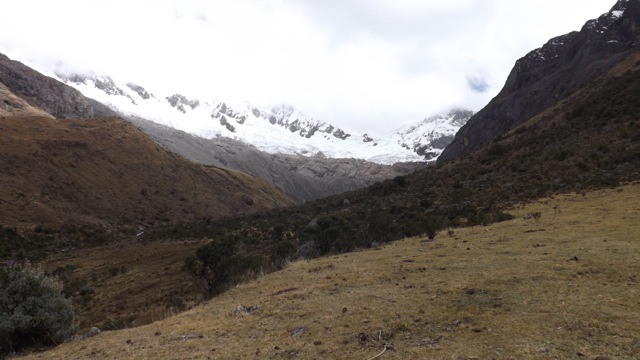
wpid-dscf2070-2013-09-13-13-32.jpg

On reaching the valley we left our packs with covers on as it had rained overnight. Even walking along the high valley without packs wasn’t easy and after a couple of kilometres I arrived exhausted at the base of the wall that climbs up to the laguna. The rest of the group decided to climb it, but I opted to stay at the bottom. I’ve seen plenty of glacier lakes in this trip, so decided to save my energy.
wpid-dscf2074-2013-09-13-13-32.jpg

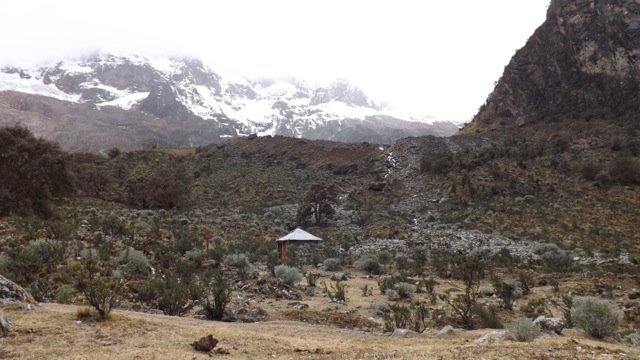
There were some buildings nearby, so I decided to investigate those instead. They were only 50m away, up a climb of about 5 metres, but even that was exhausting. The buildings were empty, but looked to have been a camping area with a place for donkeys. While I was there it began to snow a little.

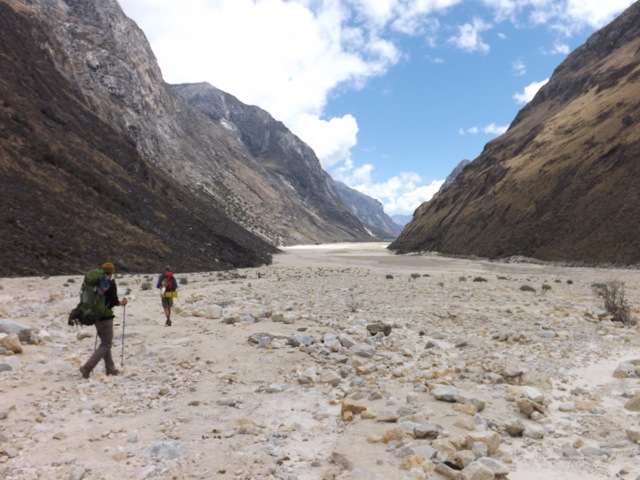
When the group returned, we headed back down the valley – an easier walk – donned out packs and climbed back down to the main valley. For the rest of the walk, we followed the valley and river along, firstly through a dry river bed thick with sand.
wpid-dscf2099-2013-09-13-13-32.jpg

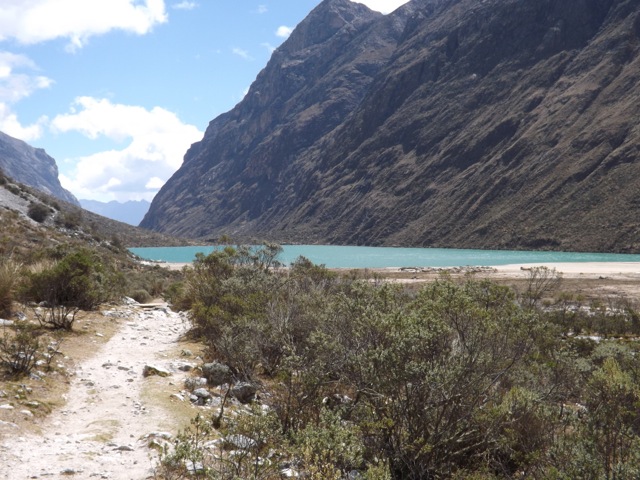
Sand is difficult to walk on carrying a pack. We climbed about 10 metres up the other bank and followed the trail that undulated as it went. We passed along the side of a large laguna and took a break for lunch at the other end as we looked along the valley.
wpid-dscf2103-2013-09-13-13-32.jpg

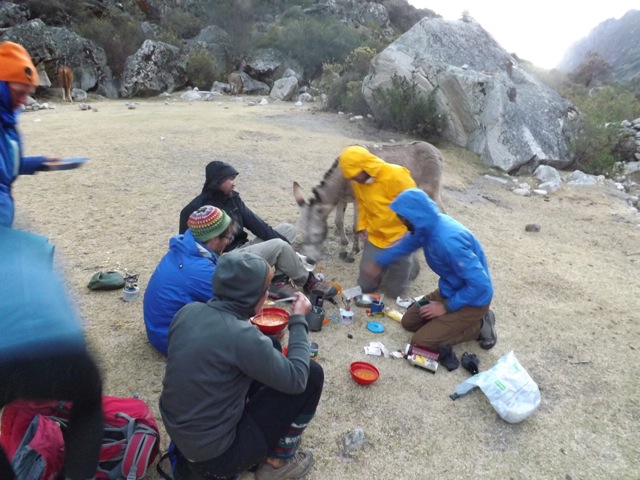
We were to pass another laguna, but it turned out to be little more than a marsh. Perhaps it’s larger in the rainy season. Cows, ponies, horses and donkeys were everywhere as we walked along the sometimes sandy, sometimes rocky trail. Eventually I saw the campsite ahead and marched off, arriving to a set of rocky walls at a place called Llamacorral. I pitched my tent as the others arrived and we began preparing dinner when we got a visit from a pony who decided he didn’t want grass for dinner.
wpid-dscf2105-2013-09-13-13-32.jpg

Later, we made a fire in a deep rocky fire pit and sat around talking for the evening.

Day 4

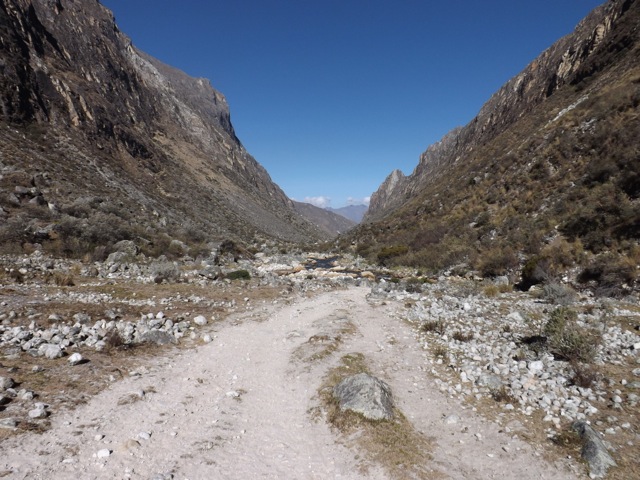
The sky was clear the next day, so after breakfast I packed up my things and headed off, walking ahead of the group for a change. Most of the day saw me walking the rocky track along the side of the valley as the river snaked its way through the landscape. There wasn’t much to see as I walked and after 90 minutes I took a short break off the trail. When I was putting my pack back on, I saw the group go past.
wpid-dscf2108-2013-09-13-13-32.jpg

I marched after them, I saw a waterfall opposite which marked the halfway point of the day. For the rest of the walk, the trail descended following the river down through the gorge. With the sun high in the sky and the sandy trail, it was very hot. A distinct contrast from the day before with its slight snow.
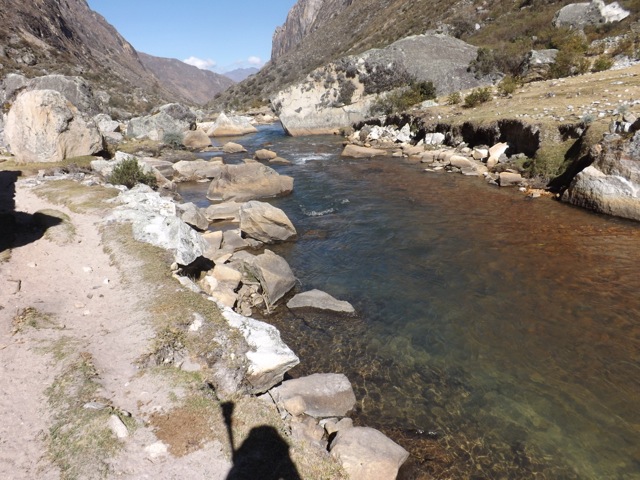
wpid-dscf2112-2013-09-13-13-32.jpg

An hour later, I rounded a bend to find my group stripping down to their underwear at a nice spot in the river. The gingerly got into the freezing water. I was steaming hot, so I stripped down and threw myself into the river. No wading here, boys and girls, the only way into a freezing river is as quickly as possible. I was out just as quickly though and drying on the side.

Then, we were off again and 20 minutes later arrived at the end of the trail after passing a group of larger people heading back the other way. I wondered how they were going to manage the climbing. They were part of a guided group, so weren’t carrying much gear, but they didn’t look as fit as my group, and we struggled at times.

Five minutes after we’d signed out of the trail, we were walking past a house and the owner rushed out offering us cold soft drinks and beer. He told us he’d call a Collectivo – mini van – for us. It would take us to a larger town where another Collectivo would take us back to Huaraz.

As we were driven away in the van, we could see the gap from which we’d exited the hike and the surrounding landscapes.
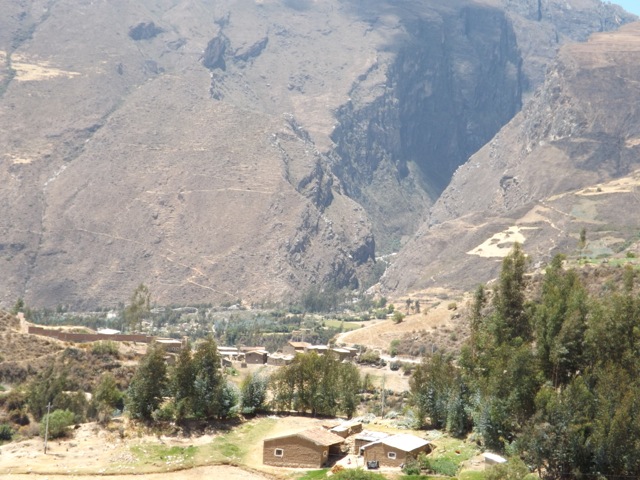
wpid-dscf2126-2013-09-13-13-32.jpg

Conclusion

Because the trek was at such altitude, it goes down in my books as being the most difficult hike I’ve ever done. With day 2 being the most difficult day’s hike, even more difficult than day three of the Colca Canyon hike. Did my week in Lima at a low altitude cause me to lose the acclimatisation I’d previously gained in Bolivia and Northern Peru? Probably. I should have given it a couple of extra days in Huaraz before I did the hike. But these are the things you learn.

Next, I’m off north to the beach city of Mancora in far northern Peru before crossing the border into Ecuador. I’ll see what adventures await me there.

The Trail Wanderer.

Colca Canyon, Peru

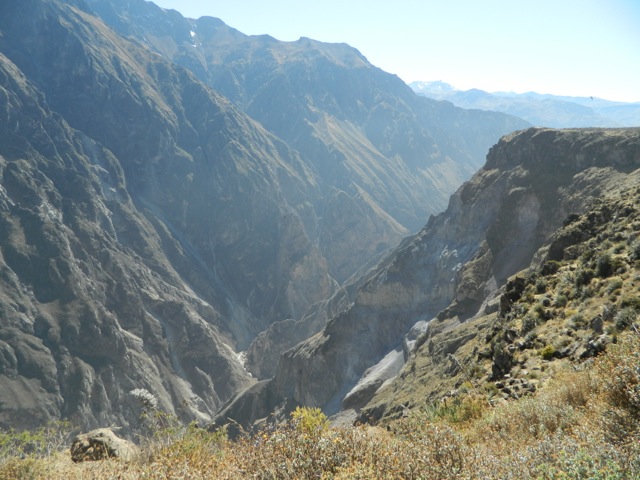
Colca Canyon is the third most visited destination in Peru and is twice as deep as the Grand Canyon in the United States. The canyon itself is just a massive yawning gorge in the middle of the vast tall mountain landscape of Peru. It’s an amazingly picturesque wonderland and a great place to spend a few days hiking.

wpid-dscn3421-2013-08-25-23-41.jpg

There are many tours into the canyon, most of them visit the same place, the tourist destination of Sangalle, also known as the Oasis. It has plentiful hotels and entertainment for those who wish to pay for a guide to lead them down the massive face of the canyon wall. And for those who can’t or don’t want to climb back out again, there are mules for hire. The Oasis…

wpid-dscn3484-2013-08-25-23-41.jpg

But a guided tour isn’t necessary. You can catch a bus from Arequipa to Cabanaconde, the township at the top of the canyon, and from there just walk into the canyon at your own timing and direction.

There’s actually quite a lot you can do in the canyon; numerous little settlements dotted across the other side, several archaeological dig sites, a waterfall high up in the mountains and a set of hot pools right on the river. You could spend a week here exploring. Plus, you don’t need camping equipment, cooking equipment or food, as it’s all available in the settlements (including beer). So, grab a couple of hundred Soles and get down there!

Day 1 – Arequipa to San Juan de Chuccho
Being picked up at 3 a.m. followed by a 7 hour bus ride is a god awful way to start a trek. Trust me on this! Especially when you’ve only managed 3 hours sleep the night before.

The bus arrived at Cabanaconde at 10 a.m. and in the heat, everyone else headed off with their guides to do their tours while I tried to find the start point of my solo hike. With the quality of the maps in general being poor and with no topographic ones at all, this was one of only tow navigation challenges I had. I asked one of the locals and was pointed out along the road the bus had come in along. A few hundred metres outside of town, I waved down a policia on a bike and he pointed me further on. At least I was on the right track. I eventually reached the San Miguel Mirador and looked back at Cabanaconde…

wpid-dscn3431-2013-08-25-23-41.jpg

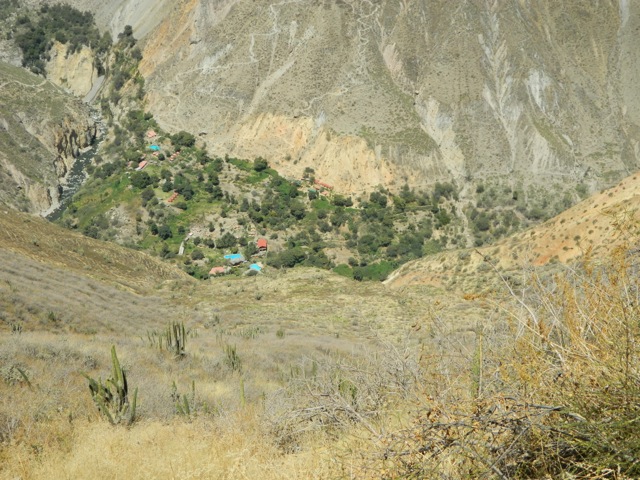
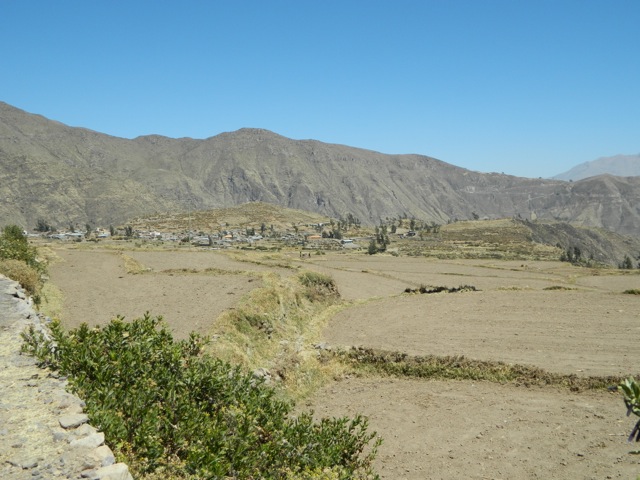
…and across at a couple of the settlements on the far side of the canyon. These two are, Malata and Cosñirwa. These are just two of about ten scattered along the canyon.

wpid-dscn3434-2013-08-25-23-41.jpg

From the mirador I continued along the edge of the cliff following the wide trail to a large shelter with no walls. I stopped for lunch out of the heat. While it’s the middle of winter it’s still hot, reminding me of summer in Victoria, Australia, or late winter in Central Australia. Like those areas it’s dry, dusty and the sun shines brightly off the light coloured dust, making it annoying to discover that my sunglasses are broken. Yay! And I haven’t even started yet! Cheap Brazilian rubbish!

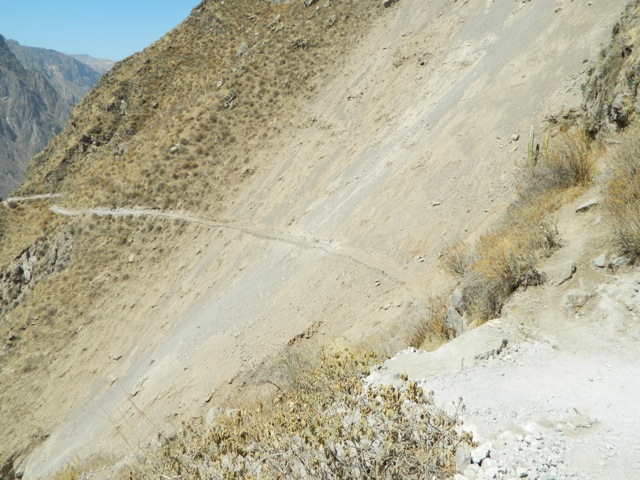
The trail is about 2 metres wide here and stays near the top of the cliff for a while. This path was recently closed because of rock slides blocking the path and while it’s officially open again, I’m still cautious.

wpid-dscn3444-2013-08-25-23-41.jpg

The trail continues on, always heading slightly downwards and I can see where the trail has been repaired in several places. The direct sunlight is very draining, not that I had much energy to start with. I come across some workman having lunch in a shelter and they point me the right way when the trail forks. The other way no longer functions, I guess.

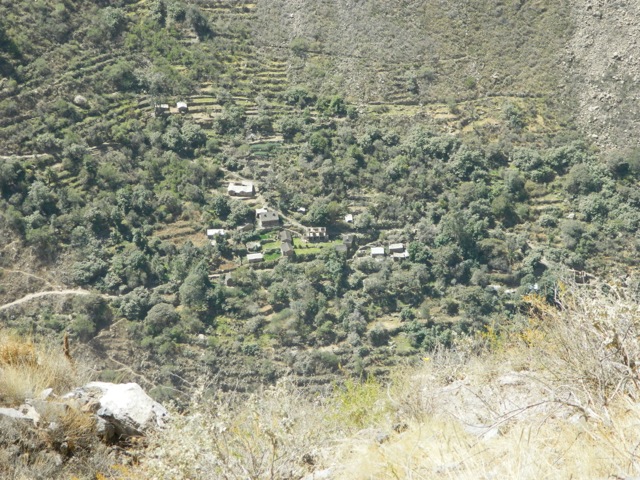
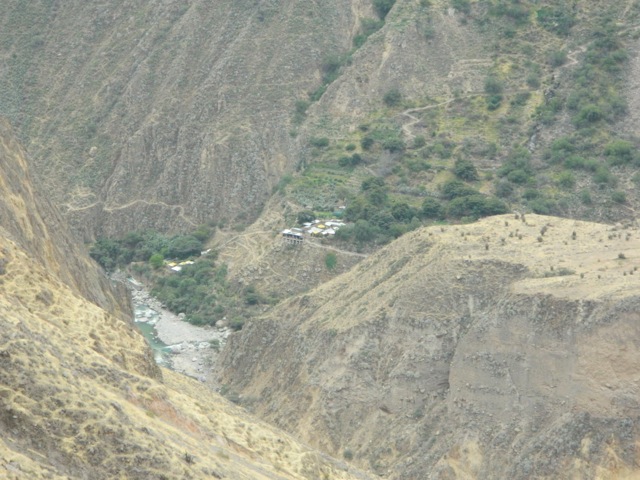
Soon I reach an area where the trail begins to zigzag down the mountain. I stop for a break and take off my boots to dry my feet – good practice on a hot hike. Looking down, I see the settlement of San Juan de Chuccho, my target for the day.

wpid-dscn3445-2013-08-25-23-41.jpg

The trail zigzags steeply the entire way down the canyon wall and is long, hot and arduous. As I descend I see the bridge across the Rio Colca still several hundreds metres below that I’m aiming for with San Juan de Chuccho 50 metres up the hill beyond it.

wpid-dscn3449-2013-08-25-23-41.jpg

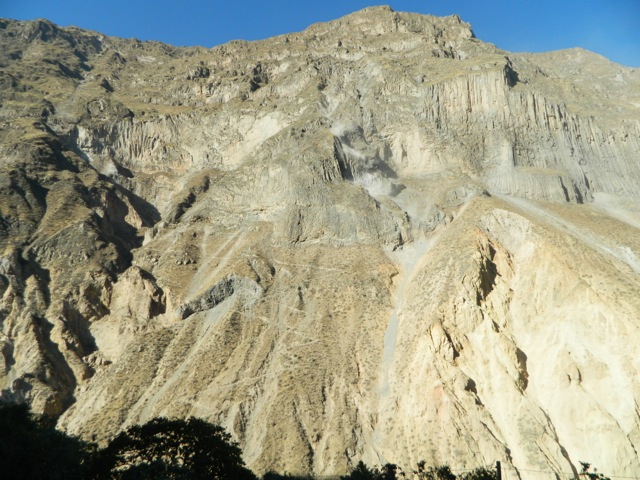
Finally, after hours in the sun I reach the bridge and take another rest. I see an arrow and the word Roy’s pointing off along the trail, so I when I muster the energy I follow. It heads further along the canyon then begins climbing to eventually come to the small set of clay huts that is San Juan de Chuccho. Roy’s, it would appear, is the name of a hotel here, the first one. I find the owner’s son – perhaps 8 – who takes me to a room. His mother appears moments later and takes me to a better one with a double bed, bathroom, hot shower, and a bay window looking directly across the canyon to the trail I’d just climbed down…

wpid-dscn3461-2013-08-25-23-41.jpg

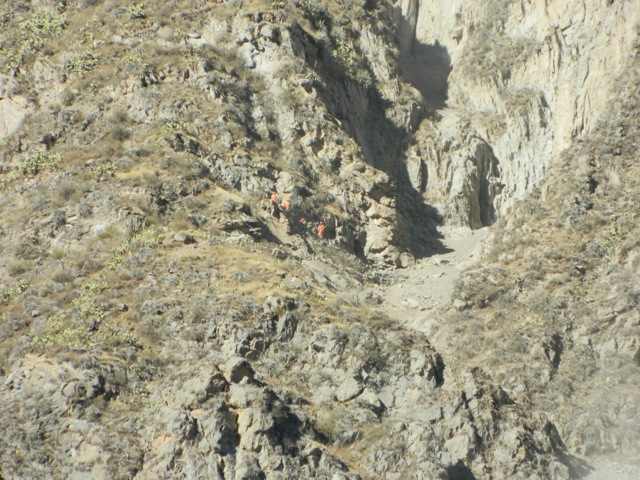
And high up on the trail, the tiny figures of the workers fixing the trail.

wpid-dscn3462-2013-08-25-23-41.jpg

The price of the room? 20 Soles or about US$7.50. Less than camping fees in many places in Australia. I bought a large bottle of beer, a large bottle of water for tomorrow and booked dinner, each for 10 Soles. That’s expensive for the beer and water, but they have to carry it in by pack mule, so I wasn’t complaining. It was a couple of hours to dinner, so I took a nap, then after dinner I collapsed into bed.

Day 2 – San Juan de Chuccho to Llahuar
After 12 hours of sleep I was made pancakes for breakfast! Hell yeah!

After breakfast I packed and was off. It was already hot when I left, heading up past another three hotels and onto the trail that would take me the length of the populated canyon face to the hot pools at the far end. The trail meandered its way along the side of the canyon for 30 minutes before rounding a corner and heading up a gully. Along the gully a water channel had been created sending water from the small stream directly back to San Juan de Chuccho. Further up the gully, the trail crossed a bridge and began zigzagging steeply up the bank. I climbed, stopping regularly in the heat. 30 minutes later I arrived at the top and into the village Cosñirwa (the first of the twin towns I showed 6 photos up).

From here a dirt road led through the village, but I don’t see a soul as I walked. On the other side of town, I follow the road up a little to the second town – Malata – a couple of hundred metres further on. I also don’t see anyone until a truck came rumbling up the road carrying passengers in the back. I guess this is the only form of bus in the canyon. I walked on and the trail forks, the road continues on, while an old trail leads up to it. I decide to follow the trail and about half way along, the footing becomes so precarious I couldn’t continue, but instead of heading back and taking the road like a normal person, I decide to climb up a rocky gully instead, about 30m with my 15kg+ pack. This was difficult and took time, but I got there with only a few scratches. I’m thankful for all that time I spent indoor rock climbing. Useful!

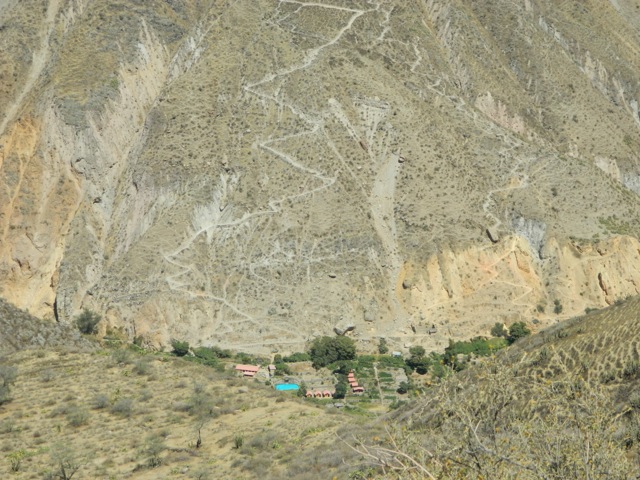
The road continued until I came to a small dugout in the rock wall where I was able to take shelter from the sun and again take my boots off. From my vantage point, I could see some of the ‘Oasis’ below and the steep zigzag trail leading down to it…

wpid-dscn3475-2013-08-25-23-41.jpg

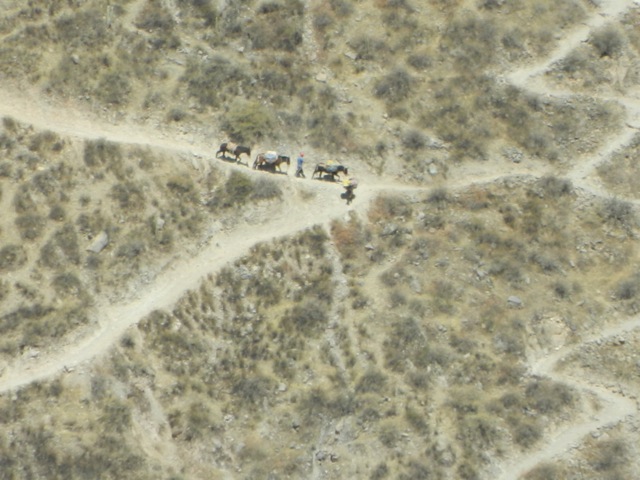
And while I watched I could see several groups climbing down it, including this laden mule caravan…

wpid-dscn3481-2013-08-25-23-41.jpg

Heading off again, I continued along the road as it slowly climbed towards mirador Apacheta, the highest point I’d climb on this side of the canyon. This gave me a view further along the canyon, with my destination down near the river.
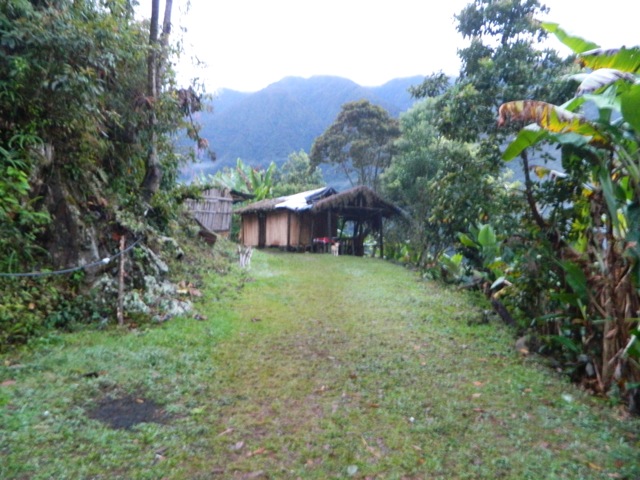
wpid-dscn3488-2013-08-25-23-41.jpg

After a break, I headed off again down a dusty path that I consider to be rather dangerous, not because of the long fall of the side of a cliff, there is that but because of the potentially painful fall into one of the three varieties of spiked cacti here. Ouch!
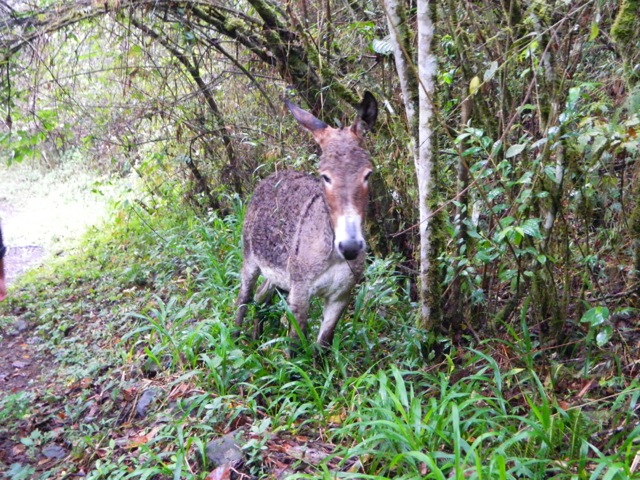
wpid-dscn3491-2013-08-25-23-41.jpg

As I headed carefully along the trail to a road and then along it, I passed two small communities, stopping at the second one for a refreshing bottle of Coca Cola. After a zigzagging climb down the next short bank, I crossed the river and headed briefly up the trail to my destination, Llahuar – pronounced ‘ya-oo-ar’ with a rolled r at the end. Two Ls together is a y sound, so Llama is pronounced Yama.

I stopped to rest and cool off with a cerveza – beer – before being shown to the aguas calientes – hot pools – belonging to the hostel, where I soaked right next to the river chatting to a solo french trekker who was doing the same. A perfect way to end a hot dusty day of trekking. Tomorrow I climb the zigzagging trail up the 1000m tall bank to the top of the canyon and back to Cabanaconde to end this little adventure. While it’s going to be difficult, being under the constant sun the entire way will make it worse.

Day 3 – Llahuar to Cabanaconde
After another 12 hour sleep, today began overcast and with pancakes for breakfast. I guess it’s difficult to bake or keep bread here… After packing, and donating some money to the French guy who hadn’t brought enough, I set off. The code of the hiker, always help other hikers in need. I climbed back up to the settlement I’d bought the coke from the day before and looked down the valley to the bridge that would mark the beginning of the hardest part of my hike.

wpid-dscn3495-2013-08-25-23-41.jpg

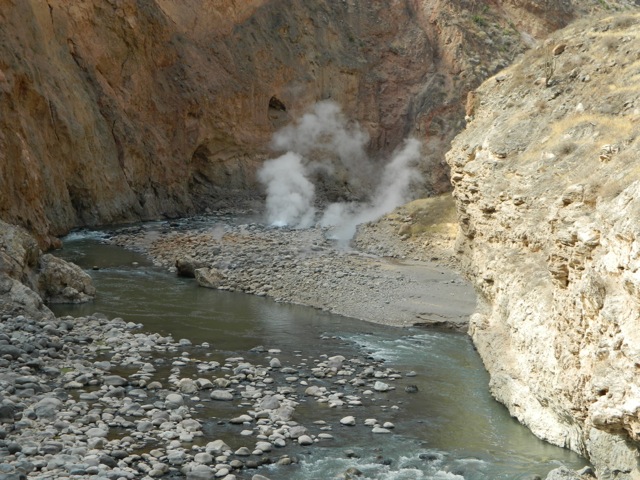
I followed the road down to the bridge and found a small natural geyser bubbling away next to the river.

wpid-dscn3497-2013-08-25-23-41.jpg

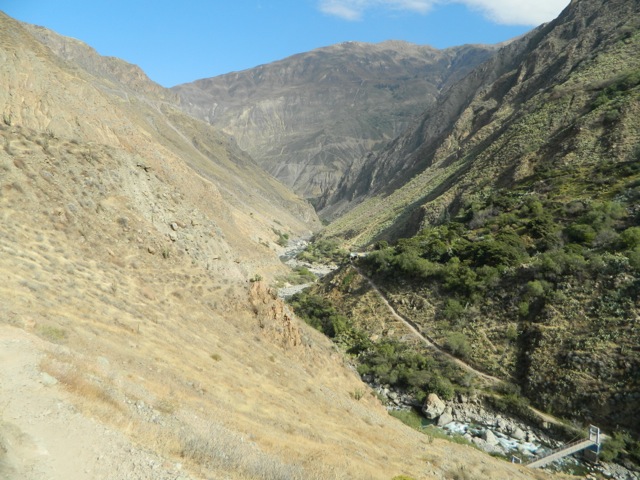
Then it was off up the trail and after climbing for 20 minutes I discovered I was going the wrong way, so had to head partially down again before finding another trail that lead me back up to the right trail. I didn’t need the extra work, but you get that. I began climbing and while it was generally overcast, and I was thankful to not be under the full sun, it was still warm. A way up the trail, I looked back down the valley to the tiny settlement of Llahuar and the pools at the edge of the river.

wpid-dscn3505-2013-08-25-23-41.jpg

A short time later, an aging local man casually comes climbing past me like he was walking up a slight hill. The trail was long and hard, and I stopped on many occasions for breaks. At point high on the canyon wall, the trail wound in along a deep gully, the first part that actually went slightly down before crossing a bridge at the top of the gully and again heading up the side of the mountain.

I finally reached the top of the canyon to discover the trail continued on along the top of the cliffs for another couple of kilometres, up and down several small hills before arriving in Cabanaconde. With the town finally in sight I quick marched to the centre plaza and found a hostel. It was a little crumby, but all I needed was a shower and a bed behind a locking door.

After my third 12 hour sleep in a row, I was on the bus and back to Arequipa, stopping briefly for a photo of the plains at the end of the canyon, before heading off again. On the way back, over the highest points – near 5000m above sea level – it snowed and I’m glad I wasn’t still in the canyon.

wpid-dscn3510-2013-08-25-23-41.jpg

Colca Canyon is a hikers’ wonderland, with so much to see. It’s not an easy walk, but for the fit there is plentiful places to visit and see, if you don’t mind climbing some pretty heavy trails with just a touch of altitude.

Next, I head north to the city of Ica, where I can gain access to the Paracas National Reserve, the Red Beaches and sand boarding.

The Lone Trail Wanderer

El Choro, Bolivia

The El Choro Trek is a three day trek that’s easily accessible from La Paz in Bolivia. I wanted to do different trek here in Bolivia, but without my own transport, many of the treks are difficult to get to. And while I tend to like hiking alone, the easiest means to do this trek is via a tour. This means I wouldn’t be carrying any food or a tent, as there will be a porter along with us to do that. This is the first time not having to carry all of my own equipment and it doesn’t feel quite right.

DAY 1 – La Paz to  Challapampa

The agency I booked through picked me up at 9.30 and I met the two other people I’d be hiking with, a french guy who spoke spanish well and some english, and an argentinian born girl who had been living in New Zealand most of her life. She spoke english and spanish perfectly. The guide with us only spoke spanish and his porter english and spanish. So, spanish became the spoken language of the trek and with my meagre understanding I decided hike alone for the most part.

The trek begins very near the start of the Death Road in a snowy mountainous area at a altitude of 4,800m. It was freezing that high up with an icy wind, so we couldn’t wait get started.

wpid-dscn2904-2013-07-26-15-23.jpg

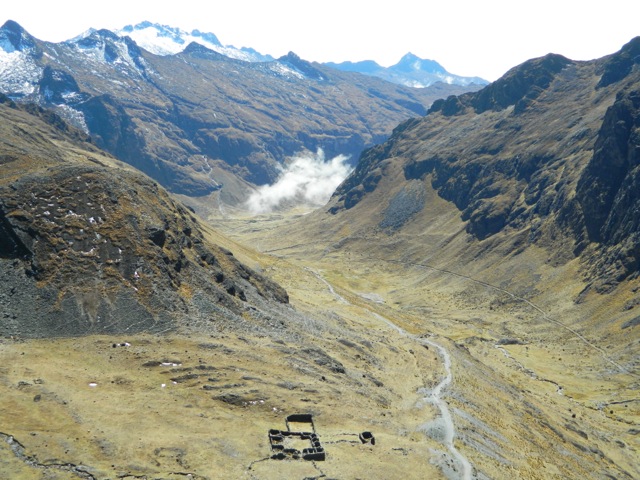
The first 100 metres of the trek climbed to the highest point of the trail, 4,900 metres. This was the hardest 100m I’ve ever climbed in my life. With such thin air, I barely got 10 steps before having to stop and get my breath back, and I was only carrying half my usual weight! Eventually, we crossed over the ridge and the cold winds ceased. Ahead of us along the valley we could see the trail through the valley and a set of ancient Incan ruins at the base of the slope. The ruins were once a rest stop for travellers on the trail. Food and shelter was always offered for free.

wpid-dscn2910-2013-07-26-15-23.jpg

The trail weaved down the side of the mountain towards the ruins and it began to slowly get warmer, so we started shedding some of our warm weather clothes. At the ruins we stopped for a rest and watched as a Llama train came by. The Llamas and their master were returning from a delivery earlier in the day.

wpid-dscn2916-2013-07-26-15-23.jpg

We pushed on along the trail that from time to time was obscured by low cloud, through fields that housed other ancient ruined buildings and walls.

wpid-dscn2925-2013-07-26-15-23.jpg

Eventually, we came to a pair of newer buildings that were being used as farms raising Llama’s and drying several different kinds of small potatoes… We stopped for 30 minutes before pushing on.

wpid-dscn2932-2013-07-26-15-23.jpg

Much of the rest of the day was spent walking through the low cloud, so visibility was only several metres, meaning the focus went on the ‘road’ we were trekking along. We were told that it was originally built by the Tiwanaku, a race of people who would eventually become the Incans, and had been repaired by the Incans, so it was difficult to tell which was which. In the clouds, the stones get very slippery.

wpid-dscn2946-2013-07-26-15-23.jpg

Our day ended upon reached the very small settlement of Challapampa, where our guide and porter set up the tents and cooked our dinner. From the high point of 4900m, we had descended to 2400m. And while it rained during the night, it was a lot warmer.

DAY 2 – Challapampa to San Francisco
wpid-dscn2953-2013-07-26-15-23.jpg

Today we hit the Cloud Forest, a fairly untouched area of the valley which is usually covered in cloud. For only short periods of the day the clouds parted, but for most of the time, we could see the cliff edge, but beyond it only cloud.

wpid-dscn2955-2013-07-26-15-23.jpg

The trail meandered along the side of the valley for much of the day, climbing and descending small hills as we trekked along the thinner ‘Incan road.’

wpid-dscn2959-2013-07-26-15-23.jpg

The valley disappearing in cloud…

wpid-dscn2967-2013-07-26-15-23.jpg

…and opening up again.

wpid-dscn2976-2013-07-26-15-23.jpg

One wonderful part of the day was the plentiful different species of wild flowers that were growing along the sides of the trail. My super zoom camera getting great close up shots of most of them.

wpid-dscn2981-2013-07-26-15-23.jpg

We stopped for lunch at a small set of huts and rested for a while. Most importantly they served cerveza! Beer, in spanish.

wpid-dscn2998-2013-07-26-15-23.jpg

The rest of the trail was fairly straight forward, again with plentiful wild flowers. We eventually reached San Francisco, a tiny collection of huts, where the guide and porter erected our tents and cooked our dinner.

wpid-dscn3008-2013-07-26-15-23.jpg

DAY 3 – San Francisco to Chairo
We left San Francisco just after day break and headed away down the hill towards a river.
wpid-dscn3015-2013-07-26-15-23.jpg

As we slowly worked our way lower through the forest, we met a couple of wild donkeys who, after being initially fearful of us, just stood there and let us go past as if we weren’t there.

wpid-dscn3017-2013-07-26-15-23.jpg

We arrived at the river and crossed on a fairly new wooden suspension bridge. We were alerted to the carcass of a horse in the river under the bridge. We stopped on the other side and prepared ourselves for the climb to come, known as Subida del Diablo – the devil’s ascent.

The Subida del Diablo gets its name because it’s a very difficult climb up slippery Incan paving stones at a fairly steep incline that just keeps climbing.

wpid-dscn3023-2013-07-26-15-23.jpg

Once at the top, we stopped for a break at a place owned by an old Japanese man. Stories say he is a war criminal fled to South America after World War 2, but who knows. There is a camping spot at the back of his property next to the cliff line giving wondrous views along the valleys until the clouds again came rushing in.

wpid-dscn3027-2013-07-26-15-23.jpg

The trek continued for some time along the trail high up in the mountains. From time to time we could see the river below us, but clouds would race in to cover it quickly. Eventually, we started our decent until we could see the village of Chairo below us. It didn’t take us long to get down to the village where the guide ordered us lunch from the local cook house and we sat eating until our van arrived to take us to Choico, where death road finishes.

wpid-dscn3033-2013-07-26-15-23.jpg

We waited in Choico for an hour before catching a minibus back to La Paz. 3 hours later I was delivered to my hostel for a well deserved shower.

Overall, El Choro was a good hike where we spent much of our time climbing down. By the end, our calves were sore from the constant descending. While the low clouds meant that much of the view was hidden from us for parts of the hike, it was still good to get out into the wilderness and away from the city for a while.

Next, I head down to southern Bolivia to the Salar de Uyuni, one of the largest salt flats in the world.

The Lone Trail Wanderer

Iguazú Falls, Argentina and Brazil – Impressions

On the border of Argentina and Brazil are the mighty Iguazú Falls.  One of the seven new wonders of the world, the falls connect a national park in each country. The falls are among the seven largest waterfalls in the world, a third larger than Niagara Falls.

DSCN2572

From the Argentinian township of Puerto Iguazú it’s easy to see both sides of the falls.  The Argentinian side has many wide cascades of water at several levels while the Brazilian side has the Devil’s Throat, a U-shaped section of the falls. Here are details of both with prices correct as at June 2013:

Argentina – Cataratas del Iguazú

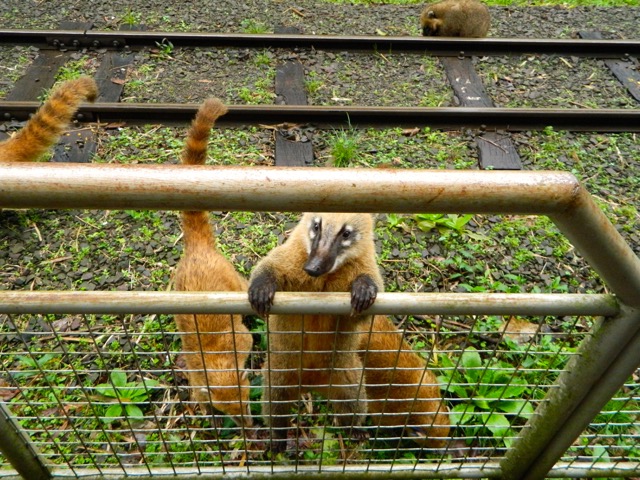
The trip from Puerto Iguazú by bus takes about 15 minutes. The Argentinian side is the more expensive of the two parks at $170 pesos (about US$34), but it has the larger tourist area. There are several different walks in the park and a boat tour that takes you up close to the cascades. The boat tour – the Gran Adventura – is fairly expensive at $350 pesos (US$70) but I booked it anyway. Near the booking area I came across some South American Coatí scavenging for food.

DSCN2571

It was raining on the day of my visit, so I bought a cheap rain poncho. After booking the Gran Adventura, I had an hour to kill so went for a walk around the park along a trail creatively named, ‘The Lower Trail’. Because of the rain and an excess of water going over the falls The Upper Trail was closed, which was a shame as it leads across a series of bridges to a platform above the Devil’s Throat.

The lower trail leads down the bank, past many smaller waterfalls to several lookouts with different views of the flatter side of the falls. At one point, the trail gets very close to the cascades where the spray is thick in the air.  Thankfully for the poncho I stayed mainly dry.

DSCN2598

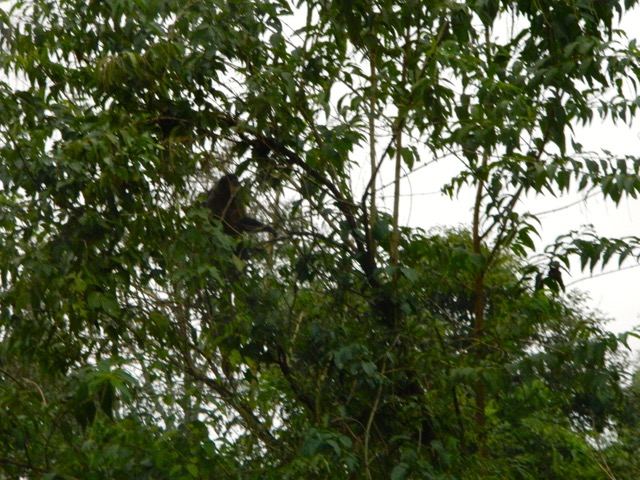
The Gran Adventura begins with a 30 minute safari through the rainforest where a guide introduces several different native trees and I got to see my first ever monkeys in the wild.

DSCN2602

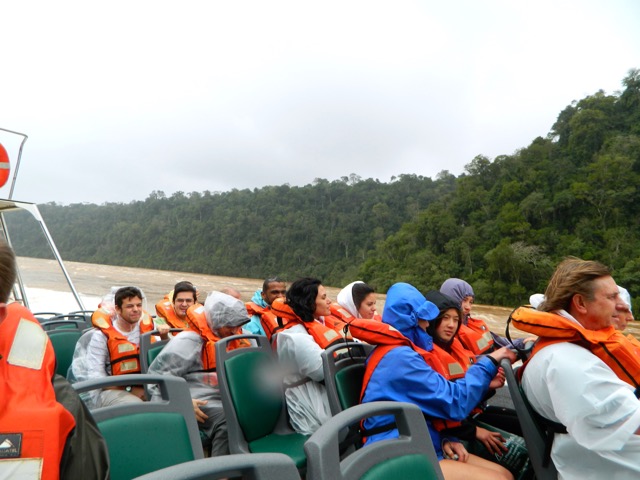
Then we were strapped into the boat and shot off at full force along the river.

DSCN2610

With so much of the thick dirty brown water coming over the falls, the water eddies like crazy and even the big jet boat was thrown around. With the amount of spray coming off the falls it was difficult to get close to the churning water coming down the Devil’s Throat…

DSCN2609

…so we spent more time getting close to and drenched by the cascades section.

DSCN2617

Then it was a crazy ride back along with the river, back into the safari trucks and out of the park.

Brazil – Cataratas do Iguaçu

The trip to the brazilian side of the falls takes about 30 minutes, including a short stop at customs. Because it’s considered a tour, no fees or visas are required.

Brazil’s park is larger overall but with a smaller tourist area. It’s cheaper at $41 Reals ($US21). To get to the viewing platforms, you need to take an internal bus which can drop you off along the way depending on what tour you want to do. They also have  boat tours similar to the Argentinian side.

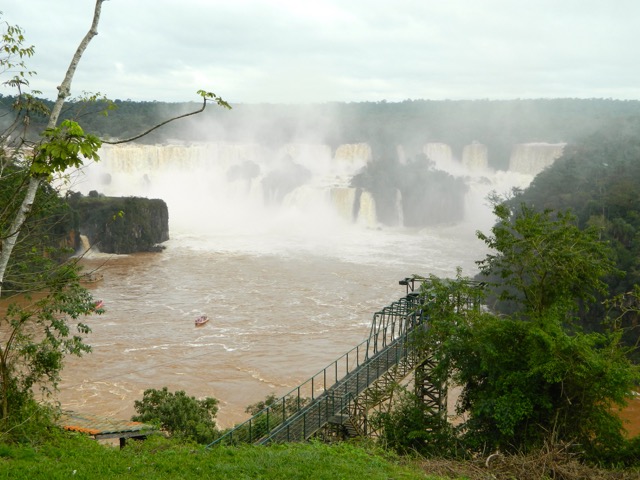
The park’s main path is slightly shorter than the Argentinian side but has better views, beginning with a view across the river to the cascades section of the falls…

DSCN2634

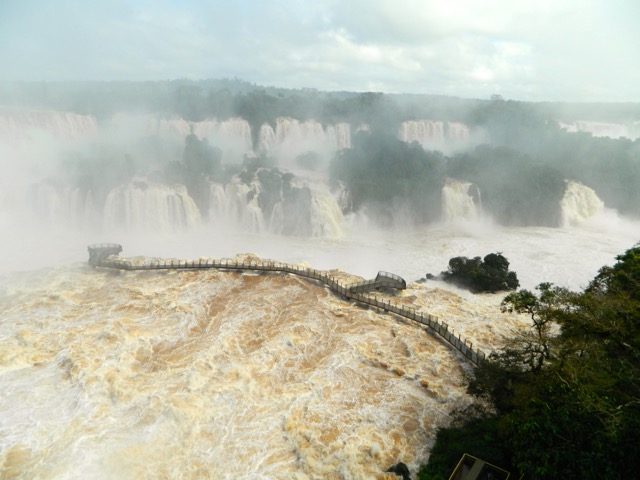
As you get closer to the Devil’s Throat, the trail zigzags up the wall to a viewing platform right at its side, which provides awesome views of the upper river pouring right down the Devil’s Throat.

DSCN2656

While there was a section also closed because of the height of the water, the views were still amazing.

DSCN2677

With no rain today there were plentiful moths and butterflies about. They will land on everything at a moments notice.  If they weren’t so colourful, they’d be considered pests.

DSCN2687

Overall, the falls are a definite must see. While you can be happy seeing just one side, it’s not hard to see both and well worth the money spent.

Next I’m off to see the wonders of Brazil and Rio De Janeiro.

The Lone Trail Wanderer

Cerro Catedral, Parque Nacional Nahuel Huapi, Argentina

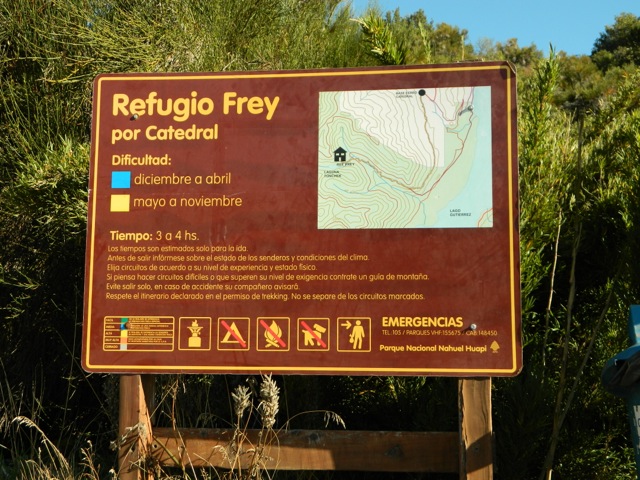
After a week studying español in Bariloche it’s time to get back out on the trail. This weekend, myself and a companion from my hostel are planning to climb Cerro Catedral (yes it’s spelt correctly) to Refugio Frey, where we plan to stay the night and do some day walking around the lakes.

wpid-dscn2359-2013-05-20-15-28.jpg

Our original plan was to do a 3-day hike, walking on to the refugio after Frey, but the amount of ice on the higher trails meant the climb beyond Refugio Frey would be too dangerous.

We packed and caught the bus for the 20km trip to the township of Catedral, a town set up for the ski slopes above it. The weather was beautifully clear when we headed out and remained that way for the entire weekend. A rare weekend for this time of the year in Bariloche and perfect for the hike.

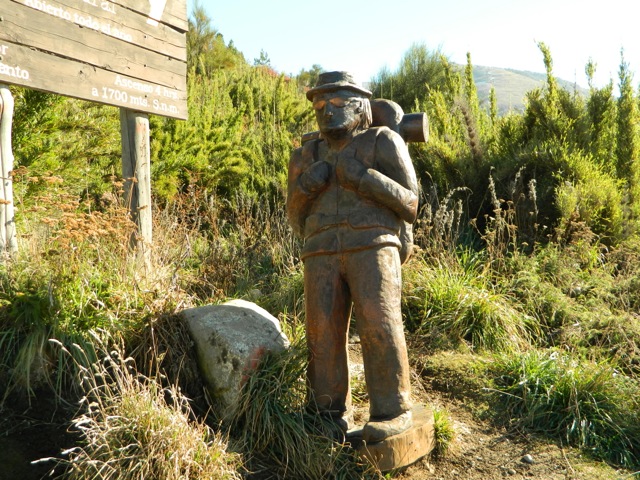
We headed out along a wide dirt road away from the huge car park for the ski fields. After a short walk, we left the road and walked up a short thin trail to the official beginning of the trail and a wooden hiker…

wpid-dscn2358-2013-05-20-15-28.jpg

The first part of the hike meandered south along the base of the rocky edifice of Catedral Norte, heading away from the chair lifts and the ski fields.

wpid-dscn2366-2013-05-20-15-28.jpg

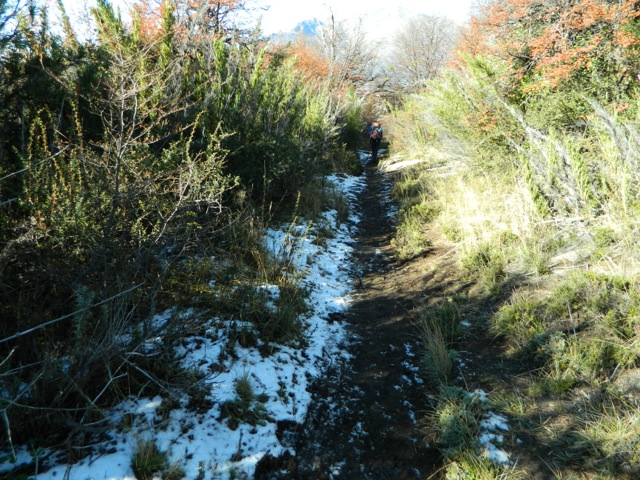
Along some parts of the trail sat snow from an earlier snowfall, although much of it had melted leaving a thin layer of mud.

wpid-dscn2365-2013-05-20-15-28.jpg

The trail continued on its fairly flat way across the southern base of the mountains heading towards Lago Gutiérrez…

wpid-dscn2371-2013-05-20-15-28.jpg

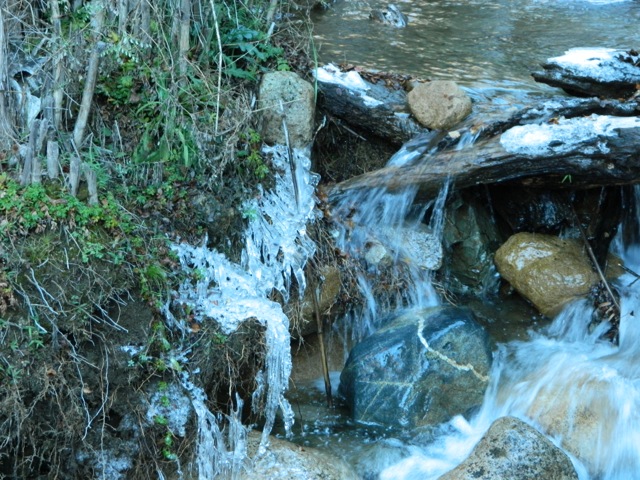
The trail crossed many small arroyos flowing down from the mountain, many flowed beneath a layer of ice. This created some very beautiful natural icy sculptures.

wpid-dscn2364-2013-05-20-15-28.jpg

The trail rounded the base of the mountains, with a clear view of the lago as we headed west up the gully towards the refugio. The trail became icy as we walked and we had to watch our steps to ensure we didn’t slip off the path. There were sections of the trail that looked like normal dirt but you could occasionally put your foot right through it leaving a 10 cm deep hole. Ice forms in layers beneath the mud, pushing it up and making it fragile. Some places it was obvious, but other places you didn’t know it was there until your foot went through it. Beneath the ice was more dirt, so it wasn’t dangerous, just strange to walk through the icy mud. The ice itself hardens into layers of hexagonal rods about 3cm thick, and there always seemed to be three layers of the ice.

Walking through a cold forest gully, we avoided as much ice as possible. The climbing began across some muddy tracks until we came to a flattened areas where an emergency hut had been built under a massive boulder. The boulder slants down making the inside back wall of the hut. Inside there is a flat platform to sleep perhaps 3 people and a fireplace.

wpid-dscn2381-2013-05-20-15-28.jpg

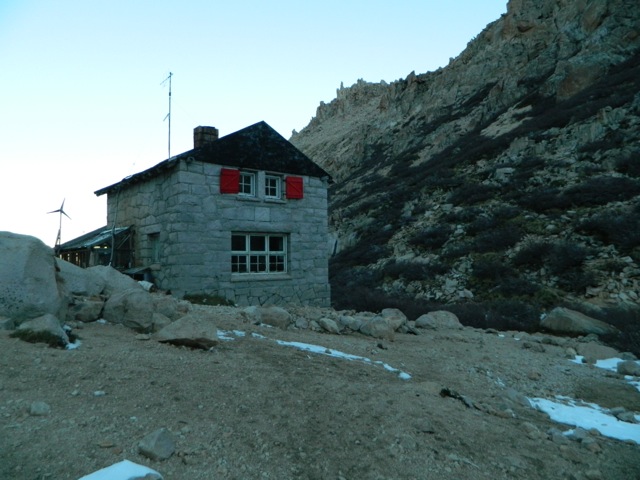
With the light starting to fade, we pushed on along the gully, sighting the roofs of buildings at the top. As we walked, the top of the Cerro Catedral range could be seen off to our right with a light dashing of snow around its jagged peaks. We continued climbing up through some slippery mud until we came over the crest and crossed an icy arroyo to see the refugio ahead of us.

wpid-dscn2391-2013-05-20-15-28.jpg

Refugio Frey is expensive to stay in and provides little more than a mattress upstairs and no heating. We cook our food in a tucked away corner and settle in for the night with several other people including 3 young and rather noisy preteen boys.

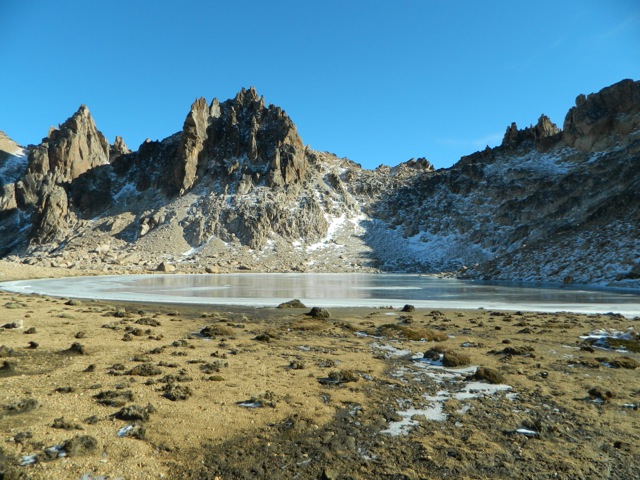
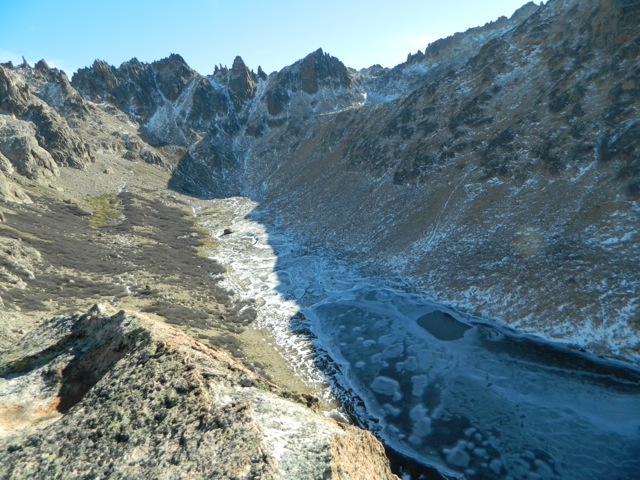
It wasn’t too cold for most of the night, but as it headed towards day break it began to grow a little colder. I arose just before sunrise and headed outside with camera to catch the sun upon the mountains at the back of the valley beyond the frozen laguna. I watched the sun shine pink on the mountains opposite before lighting them up in a golden light.

wpid-dscn2396-2013-05-20-15-28.jpg

We decided to climb the wall of the valley to Laguna Schmoll. To get to the other end of the valley we decided to walk across the frozen lake. This was rather fun as it was fairly solid. The children at the refugio got out on their ice skates and stayed there for much of the day. At the far side of the laguna is the arroyo that feeds it, we walked across the ice but this wasn’t as solid and I broke through on two separate occasions. Thankfully, my trusty boots are waterproof, so it wasn’t too much of a worry.

The climb up the rocky wall of the valley was fairly easy, although there was snow in several places and some ice. This part could have been climbed with packs, but it was the next part that we weren’t supposed to do without crampons.

wpid-dscn2410-2013-05-20-15-28.jpg

Another pair of hikers had also climbed to the laguna, but they couldn’t speak english and I’m not totally confident with my spanish yet, so I left my companion to chat with them while I investigated this new valley.

wpid-dscn2411-2013-05-20-15-28.jpg

After stopping for lunch, my companion and the two other climbers decided to climb the icy wall without crampons (or packs). I scouted it a little and decided against it and let them go. On the other side of the lower valley is a ridge that leads to another set of peaks. This is sun drenched and has no snow or ice on it, so I decided to climb this instead.

I made my way back down the rocky wall and around the side of the laguna towards the short ridge, with the refugio across the lake.

wpid-dscn2420-2013-05-20-15-28.jpg

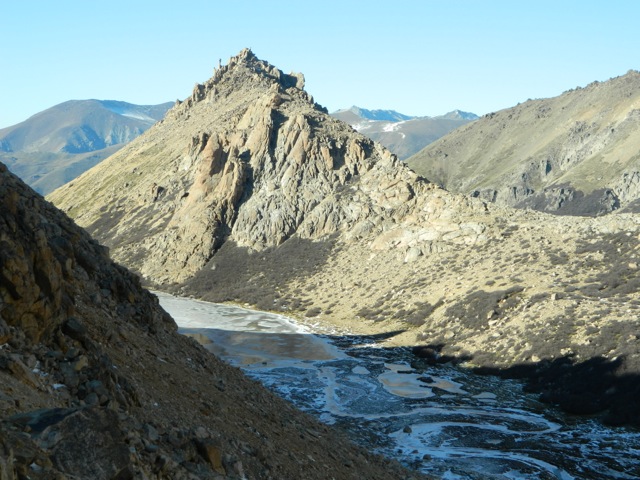
Then in the warmth of the sun, I made my way up the side of the ridge. It was an easy climb and standing atop it could see down both valleys. This is the mountain Pico Bara at the end of the ridge…

wpid-dscn2407-2013-05-20-15-28.jpg

The climb up Pico Bara was fairly easy and there were several different ways to climb it. It was a lot of fun, crossing from the back side with some snow, to the sunny side and back again. The views from the top were pretty impressive, both looking back along the valley…

wpid-dscn2429-2013-05-20-15-28.jpg

…and down upon the refugio a couple of hundred metres below.

wpid-dscn2427-2013-05-20-15-28.jpg

After a brief stop in the chilly wind, I headed down again. It didn’t take me very long to reach the bottom, where I met up with my companion and donning our packs we headed off back down the mountain.

The trip down was a lot quicker than the climb, as you can imagine. It had taken us about 4 hours under pack to climb to Refugio Frey and 2 hours and 30 minutes down again. We were really pushing it, but still missed the earlier bus by 15 minutes. We waited another hour over a couple of beers and caught the next bus back to Bariloche for a well deserved shower.

The Trail Wanderer

Montezuma Falls – West Tasmania

My trip to Tasmania has been rather interesting. I’m sure there’s an Aboriginal name for it which likely means: ‘Land where it rains, oh and some mountains’. That sure wraps it up for me so far!

After spending several days in Hobart, it’s time to move on. As I’d driven along the east coast to Freycinet then the south coast to Hobart, I figured I should go see the west coast. So, I pointed The Pointy Brick west and drove.

Strahan is a tourist port town on the west coast set on the north side of a large harbour. It and the raging sea to the west – 8000km to Argentina – is beautiful.

There are places to climb on this side of the state, but as I don’t climb in the rain, I looked for something else to do. Rain tends to make waterfalls look awesome, so I decided to go find one of the biggest in Tasmania. In the rain, I drove 50 km inland to the turnoff and then 6km further to the car park.

wpid-dscn0854-2012-12-18-18-10.jpg

The trail to the waterfall is 4.8km and is graded easy. The first thing I came to was a bridge across the river to the main trail.

wpid-dscn0856-2012-12-18-18-10.jpg

The trail was stony, although with all the rain, it was often waterlogged and muddy. Thankfully I’d decided to wear my hiking boots, so my feet remained dry.

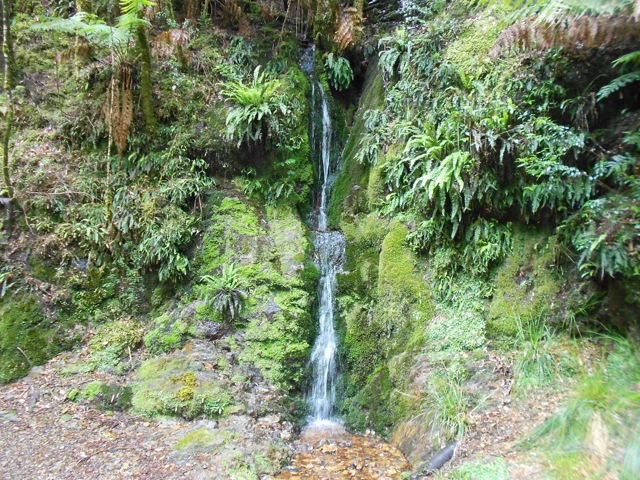
The trail meanders through the rainforest, following the river. In places along the route there are smaller waterfalls…

wpid-dscn0859-2012-12-18-18-10.jpg

This one only as tall as I am…

wpid-dscn0860-2012-12-18-18-10.jpg

This area of the mountains used to be an old mining area and the trail itself is where the old tram line used to run.

wpid-dscn0865-2012-12-18-18-10.jpg

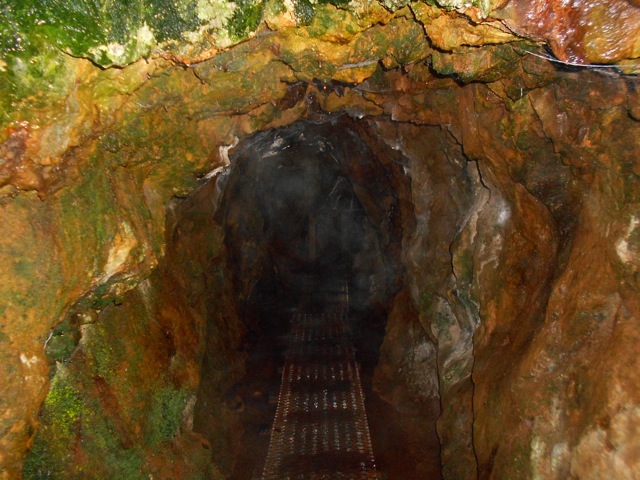
Towards the end you are able to enter an old mine shaft for a short distance…

wpid-dscn0869-2012-12-18-18-10.jpg

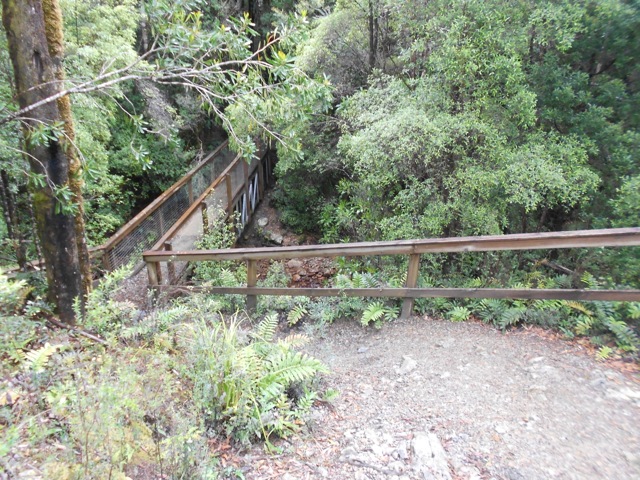
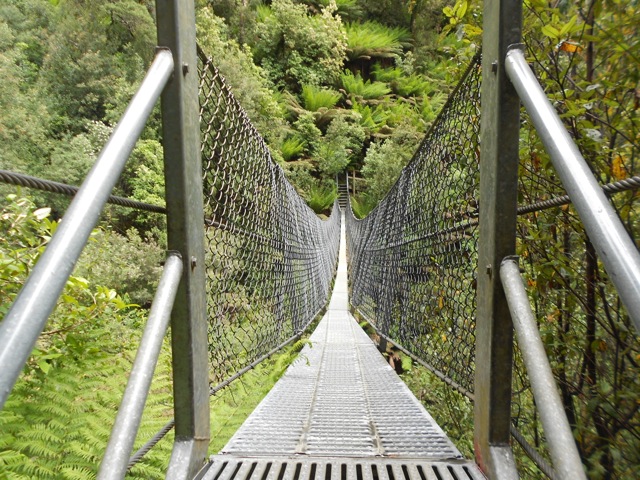
Then with the roar of water ahead, you reach a cable bridge heading out of the undergrowth.

wpid-dscn0871-2012-12-18-18-10.jpg

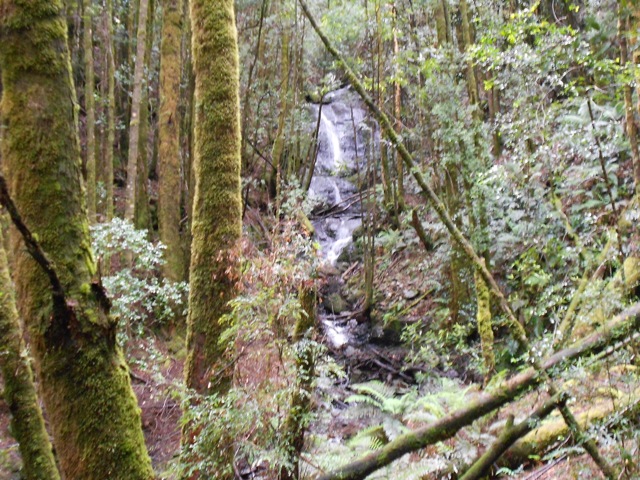
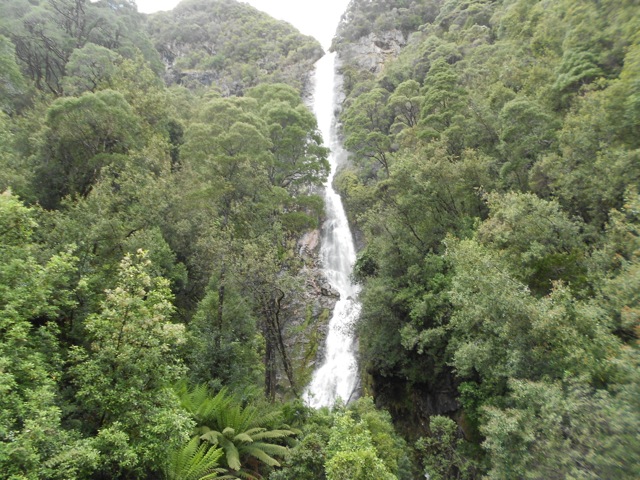
Halfway across the bridge is the best place to see the 104m falls that flows under the bridge and down along the valley…

wpid-dscn0873-2012-12-18-18-10.jpg

While it was a long walk to see a waterfall, it was worth the effort. A beautiful place in Tasmania worth visiting.

Tomorrow, I head to Mole’s Creek where I’ll be doing a full day Adventure Caving in the caving capital of Tasmania.

The Lone Trail Wanderer